How the Louvre Survived World War II: The Great Art Evacuation of 1939

Eleanor Whitfield
26 June 2026
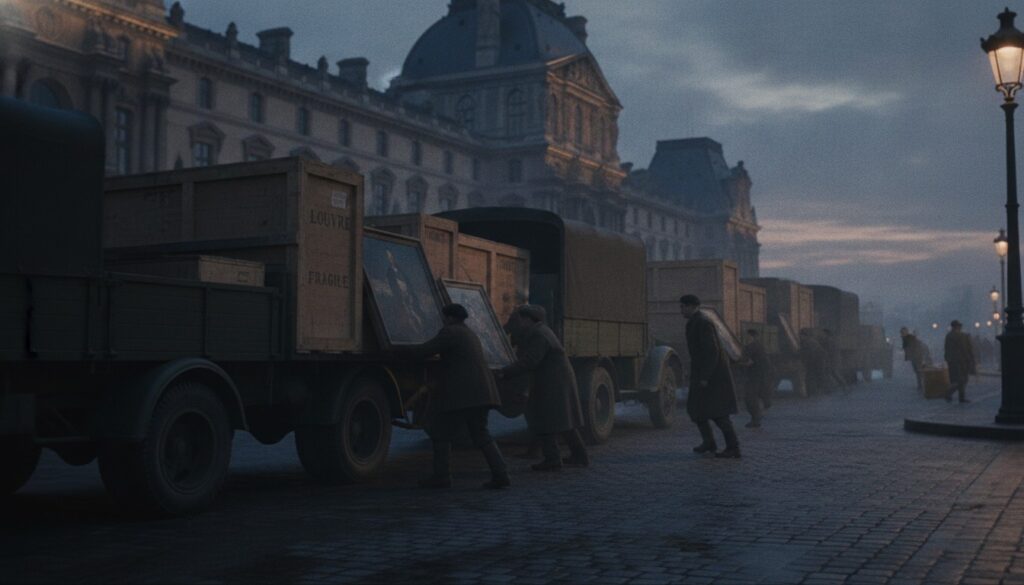
How the Louvre Survived World War II: The Great Art Evacuation of 1939
Introduction
In the summer of 1939, with the shadow of war darkening over Europe, an extraordinary secret operation was set into motion beneath the grand halls of the Louvre. While diplomats scrambled and armies mobilized, a small army of museum curators, art handlers, volunteers, and ordinary Parisians undertook one of the most ambitious cultural rescue missions in human history. Over the course of just a few frantic days, thousands of priceless masterpieces — including the Mona Lisa, the Winged Victory of Samothrace, and the Venus de Milo — were carefully packed, loaded onto convoys of trucks, and spirited away to secret locations scattered across the French countryside.
This is the gripping, largely untold story of how the Louvre survived World War II — not through luck or divine intervention, but through meticulous planning, extraordinary courage, and an unwavering belief that art belongs to all of humanity and must be protected at any cost.
The Gathering Storm: Why the Louvre Prepared for the Worst
The idea of evacuating the Louvre’s collection was not born overnight. Museum officials had been quietly preparing for the possibility of war since the mid-1930s, watching with growing alarm as Adolf Hitler’s territorial ambitions expanded across Europe. The lessons of World War I — during which some artworks had been damaged or hastily relocated — were still fresh in institutional memory.
As early as 1938, Jacques Jaujard, the visionary director of the French National Museums, began drawing up detailed evacuation plans. Jaujard was a man of quiet determination and deep conviction. He understood that if Paris fell, the Louvre’s treasures would become prime targets — either for destruction or, more likely, for systematic looting by the Nazi regime, which had already demonstrated its appetite for plundering cultural heritage.
“A nation’s art is its soul. To lose it is to lose everything.” — Attributed to Jacques Jaujard
Jaujard’s plan was breathtaking in its scope:
- Every single artwork in the Louvre was catalogued and assigned a priority level.
- Evacuation routes were mapped to dozens of châteaux and country estates across France.
- Custom crates and packing materials were secretly manufactured and stored within the museum.
- Color-coded labels were devised — red dots for the most important works, yellow and green for others — so that packers could work quickly under pressure.
- 3,690 paintings were removed from the Louvre, including works by Rembrandt, Vermeer, Delacroix, and Rubens.
- Hundreds of sculptures were carefully dismantled and crated, including the Winged Victory of Samothrace, which required a specially built wooden ramp to slide her down the museum’s grand staircase.
- Thousands of decorative arts, antiquities, and drawings were packed into crates of every size.
- A fleet of 203 trucks made multiple trips over several days, forming convoys that stretched for miles along French country roads.
- Château de Chambord — The massive Renaissance palace became the central depot, housing thousands of crates in its vast halls and corridors.
- Château de Valençay — Home to some of the Louvre’s most important Greek and Roman antiquities, including the Venus de Milo and the Winged Victory.
- Château de Montal — Stored major paintings in climate-controlled rooms maintained by dedicated curators.
- Château de Sourches — Housed Egyptian and Near Eastern antiquities.
- Abbaye de Loc-Dieu — A remote abbey in the Aveyron region that sheltered the Mona Lisa for a period.
- Cultural heritage is fragile. From the destruction of Palmyra by ISIS to the burning of Brazil’s National Museum in 2018, we are constantly reminded that the world’s artistic and cultural treasures are vulnerable to conflict, neglect, and disaster.
- Preparation saves everything. Jaujard’s years of meticulous planning made the difference between salvation and catastrophe. Modern museums around the world now maintain detailed emergency evacuation plans inspired, in part, by the Louvre’s example.
- Individual courage matters. The story is ultimately about people — Jaujard, Valland, the anonymous volunteers, the château guardians — who chose to risk their lives for something larger than themselves.
- Art belongs to humanity. The curators who saved the Louvre’s collection didn’t do it for France alone. They did it because they understood that these works belong to every person on Earth, across every generation.
- The grand staircase where the Winged Victory stands is the same staircase down which she was carefully slid on a wooden ramp in 1939.
- The Salle des États, where the Mona Lisa now hangs behind bulletproof glass, was once an empty, echoing chamber during the occupation years.
- The Jeu de Paume, just across the Tuileries Garden, is now an art gallery — but it was once Rose Valland’s secret battlefield.
- The Rape of Europa — A documentary and book by Lynn H. Nicholas that covers the broader story of art looting and protection during WWII.
- Saving Mona Lisa by Gerri Chanel — A detailed account of the Louvre evacuation.
- The Monuments Men by Robert M. Edsel — The story of the Allied soldiers who helped recover stolen art.
The Great Exodus: Moving Masterpieces Under Cover of Night
On August 25, 1939 — just one week before Germany invaded Poland — Jaujard gave the order. The Louvre closed its doors to the public under the pretense of “repairs,” and the evacuation began immediately.
What followed was a scene of organized chaos that would have been almost comical if the stakes hadn’t been so devastatingly high. Hundreds of volunteers — including museum staff, art students, department store employees from the Samaritaine and Bazar de l’Hôtel de Ville, and even actors from the Comédie-Française — descended on the museum to help with the packing.
The Mona Lisa’s Secret Journey
The Mona Lisa received the most careful treatment of all. Leonardo da Vinci’s masterpiece was placed in a specially constructed, red velvet-lined case marked with three red dots — the highest priority designation. It was loaded onto an ambulance (chosen for its suspension system, which would minimize vibrations) and driven through the night to the Château de Chambord in the Loire Valley, one of the largest and most remote châteaux in France.
Over the course of the war, the Mona Lisa would be moved six times to stay ahead of advancing German forces, traveling to locations including the Château d’Amboise, the Abbaye de Loc-Dieu, and the Musée Ingres in Montauban. At each stop, curators maintained strict climate controls and security, often sleeping beside the painting to ensure its safety.
A Convoy of Culture
The scale of the evacuation was staggering:
Hidden in Plain Sight: The Châteaux Network
The artworks were dispersed across dozens of locations throughout the French countryside, a deliberate strategy to ensure that no single bombing raid or seizure could destroy the entire collection. The primary destinations included:
The Threat of Nazi Looting
The danger was far from theoretical. The Nazi regime had established the Einsatzstab Reichsleiter Rosenberg (ERR), a systematic art-looting organization that plundered museums, galleries, and private collections across occupied Europe. Hermann Göring personally visited Paris multiple times to select artworks for his private collection.
Jacques Jaujard played a dangerous double game throughout the occupation. While outwardly cooperating with German authorities, he secretly maintained contact with the French Resistance and ensured that the locations of the hidden artworks were never fully revealed to the occupiers. His assistant, Rose Valland, became one of the war’s unsung heroes — she secretly documented every artwork that the Nazis seized from the Jeu de Paume gallery (used as a sorting depot for looted art), compiling records that would later prove invaluable in recovering stolen treasures after the war.
Rose Valland risked her life every single day for four years, quietly recording the destinations of looted artworks while pretending not to understand German. Her meticulous notes helped the Allies recover over 60,000 stolen works of art.
Liberation and Return: Bringing the Art Home
As Allied forces advanced across France in the summer of 1944, a new danger emerged: the retreating German army might destroy the châteaux and their contents out of spite, or the artworks could be caught in crossfire during liberation battles.
Jaujard once again proved his strategic brilliance. He coordinated with the French Resistance and Allied commanders to ensure that the châteaux housing Louvre artworks were identified and protected during military operations. In several cases, Resistance fighters physically guarded the storage sites, preventing both German destruction and accidental Allied bombing.
One of the most dramatic moments came during the liberation of Paris in August 1944. As fighting raged in the streets, Jaujard personally ensured that the Louvre building itself was protected. German forces had mined the Tuileries Garden adjacent to the museum, and there were fears that the Louvre could be caught in the explosions. Fortunately, the rapid advance of Free French forces under General Leclerc prevented the worst.
The Triumphant Homecoming
The process of returning the artworks to the Louvre began almost immediately after liberation and continued through 1945 and into 1946. Each work was carefully inspected, restored if necessary, and reinstalled in its proper gallery. Remarkably, the vast majority of the collection survived the war completely unscathed — a testament to the extraordinary care taken during the evacuation and storage.
The Mona Lisa returned to the Louvre in June 1945, and when the museum reopened its doors to the public, Parisians lined up for hours to see their beloved masterpieces once again. It was a moment of profound emotional significance — a symbol that French culture, like France itself, had survived.
Lessons for Today: Why This Story Still Matters
The story of the Louvre’s wartime evacuation is more than a historical curiosity. It carries powerful lessons that resonate deeply in our own time:
“In the end, the greatest weapon against barbarism is not a gun or a bomb — it is the stubborn, quiet insistence that beauty and truth must endure.”
Visiting the Louvre Today: Echoes of Wartime Heroism
If you visit the Louvre today, you’ll find very few visible traces of this extraordinary chapter in its history. The galleries are serene, the masterpieces hang in their accustomed places, and millions of visitors pass through each year without knowing how close these treasures came to being lost forever.
But if you look carefully, the echoes are there:
Conclusion
The great art evacuation of 1939 stands as one of the most remarkable acts of cultural preservation in human history. In the face of unimaginable danger, a dedicated group of curators, volunteers, resistance fighters, and ordinary citizens chose to protect the irreplaceable treasures of the Louvre — not because they were ordered to, but because they believed that art is worth saving.
Their story reminds us that museums are not just buildings filled with objects. They are living repositories of human achievement, and their survival depends on the courage and commitment of the people who care for them. The next time you stand before the Mona Lisa or gaze up at the Winged Victory of Samothrace, take a moment to remember the extraordinary journey these works have taken — and the heroes who made sure they would still be there for you to see.
Share This Story
Did this story move you? Share it with fellow art lovers, history enthusiasts, and anyone who believes in the power of cultural preservation. Subscribe to our blog for more fascinating stories from the history of the Louvre and the world’s great museums. And if you’re planning a visit to Paris, consider exploring the lesser-known corners of the Louvre where the echoes of this incredible wartime saga still linger.
Have a question or a story of your own about wartime art preservation? Leave a comment below — we’d love to hear from you.