The Louvre: From Medieval Fortress to the World’s Greatest Museum

Eleanor Whitfield
26 June 2026
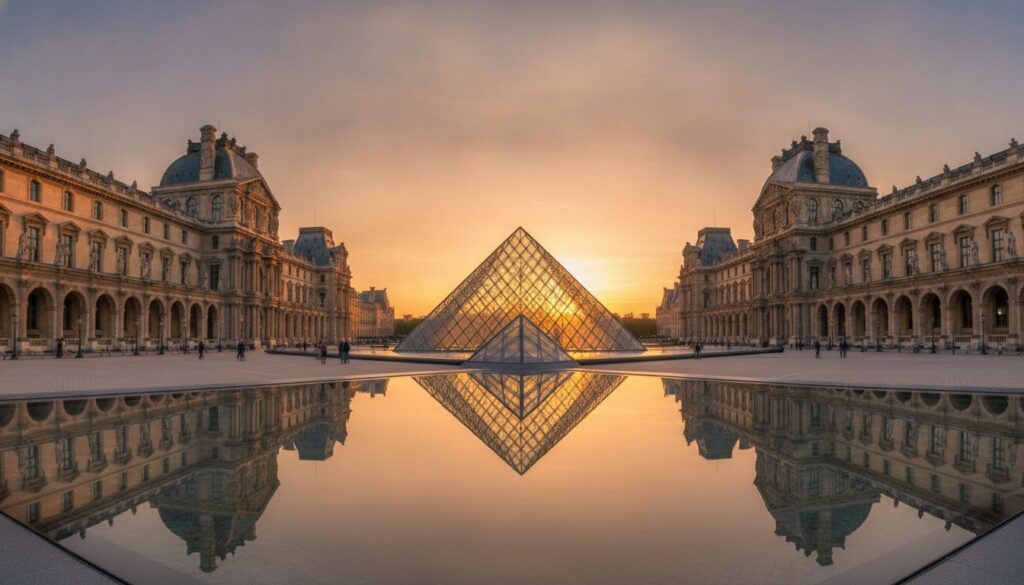
The Louvre: From Medieval Fortress to the World’s Greatest Museum
Few buildings on Earth have witnessed as much history as the Louvre. Today, nearly 10 million visitors walk through its glass pyramid entrance each year, making it the most visited museum on the planet. But long before tourists lined up to glimpse the enigmatic smile of the Mona Lisa, this iconic Parisian landmark served an entirely different purpose — one forged in stone, strategy, and royal ambition.
The story of the Louvre is not simply the story of a museum. It is the story of France itself — a narrative spanning more than 800 years, encompassing medieval warfare, Renaissance splendor, revolutionary upheaval, and cultural triumph. In this post, we’ll trace the remarkable transformation of the Louvre from a 12th-century military fortress into the world’s greatest temple of art.
The Fortress Origins: A Stronghold on the Seine (1190–1360)
The Louvre’s story begins not with art, but with war. In 1190, King Philippe Auguste (Philip II) was preparing to depart on the Third Crusade. Concerned about the vulnerability of Paris — particularly its western flank along the Seine — he ordered the construction of a massive fortress on the river’s right bank.
This original Louvre was nothing like the elegant palace we see today. It was a formidable defensive stronghold, featuring:
- A large central keep (donjon) roughly 15 meters in diameter
- Thick curtain walls with defensive towers
- A deep moat fed by the Seine
- A garrison designed to protect Paris from English and Norman attacks
- He added large windows to the formerly narrow arrow slits
- He installed luxurious living quarters and reception halls
- He housed his famous royal library of over 900 manuscripts within the tower — one of the largest collections in medieval Europe
- He surrounded the fortress with elaborate gardens
- He demolished the old medieval keep in 1528, signaling a definitive break with the fortress past
- He commissioned architect Pierre Lescot to design a new Renaissance-style palace on the site
- The arrival of masterpieces from Italy, including works by Raphael, Titian, and Veronese
- The acquisition of ancient Egyptian artifacts, spurred by Napoleon’s 1798 Egyptian campaign
- The famous Venus de Milo, acquired in 1820 shortly after Napoleon’s fall
- The Winged Victory of Samothrace, discovered in 1863 and installed on the grand staircase
- Ancient Near Eastern antiquities (Mesopotamian, Assyrian)
- Egyptian antiquities (including the Great Sphinx of Tanis)
- Decorative arts from across European history
- Thousands of additional paintings, sculptures, and drawings
- The excavation and display of the medieval fortress foundations
- A vast underground entrance hall (Hall Napoléon) beneath the pyramid
- The relocation of the French Ministry of Finance out of the Richelieu Wing, freeing up enormous gallery space
- Modernized climate control, lighting, and visitor amenities
- Egyptian Antiquities
- Near Eastern Antiquities
- Greek, Etruscan, and Roman Antiquities
- Islamic Art
- Sculptures
- Decorative Arts
- Paintings
- Prints and Drawings
- Book tickets online in advance — the Louvre requires timed-entry reservations, and walk-up lines can be extremely long
- Visit on Wednesday or Friday evenings when the museum stays open until 9:45 PM; crowds thin dramatically after 6 PM
- Avoid Tuesdays (the museum is closed) and the first Sunday of the month (free entry means massive crowds)
- Download the official Louvre app for interactive maps and curated tour routes
- Enter through the Porte des Lions or Carrousel du Louvre entrances to avoid the pyramid queue
- Focus on one or two departments per visit rather than trying to see everything — the museum is simply too vast for a single day
- The Medieval Fortress Foundations (Sully Wing, lower level) — the Louvre’s oldest surviving structures
- The Crown Jewels of France (Apollo Gallery) — including the 140-carat Regent Diamond
- Vermeer’s “The Lacemaker” — a tiny, exquisite masterpiece often overlooked by crowds rushing to the Mona Lisa
- The Islamic Art Galleries — housed beneath a stunning undulating glass roof, opened in 2012
- Napoleon III’s Apartments (Richelieu Wing) — lavishly preserved state rooms that showcase Second Empire opulence
“The Louvre was born not from a love of beauty, but from a fear of invasion. Its earliest stones were laid in defiance, not in celebration.”
The fortress served its military purpose admirably for over a century. It guarded the city’s western approach, stored the royal treasury, and even functioned as a prison for notable captives. Remarkably, visitors to the Louvre today can still see the excavated foundations of Philippe Auguste’s original fortress in the museum’s underground Sully Wing — a haunting reminder of the building’s martial origins.
A Fascinating Archaeological Discovery
During renovations in the 1980s as part of the Grand Louvre project, archaeologists uncovered the base of the original medieval keep and sections of the fortress walls. These ruins, now preserved and open to the public, offer a visceral connection to the Louvre’s earliest chapter. Walking through these dimly lit underground passages, you can almost hear the clank of armor and the shouts of medieval soldiers.
The Royal Transformation: From Fortress to Palace (1360–1682)
The Louvre’s metamorphosis from military installation to royal residence began in the 14th century under King Charles V (r. 1364–1380). Charles was a scholarly, cultured monarch who saw potential in the old fortress beyond its defensive capabilities. He undertook significant renovations:
The Renaissance Revolution
The most dramatic architectural transformation came under King François I (r. 1515–1547), a passionate admirer of Italian Renaissance culture. François I made two decisions that would forever alter the Louvre’s destiny:
“François I didn’t just rebuild the Louvre — he reimagined it. He planted the seed of the idea that this place could be a home not just for kings, but for art itself.”
Subsequent monarchs continued to expand and refine the palace. Henri IV (r. 1589–1610) connected the Louvre to the nearby Tuileries Palace via the spectacular Grande Galerie — at nearly 500 meters long, it was one of the longest buildings in the world. Louis XIII and Louis XIV further enlarged the complex, with Louis XIV commissioning the magnificent Colonnade on the eastern façade, designed by Claude Perrault.
However, in 1682, Louis XIV made a fateful decision: he moved the royal court to the Palace of Versailles. The Louvre was effectively abandoned as a primary royal residence. For the next century, the vast palace fell into relative neglect, occupied by artists, squatters, and various royal academies.
Birth of the Museum: Revolution and Reinvention (1793–1900)
The French Revolution of 1789 changed everything. As the monarchy crumbled, revolutionary leaders debated what to do with the enormous royal palace and its vast art collections. The answer came on August 10, 1793, when the Louvre officially opened its doors as a public museum — the Muséum central des arts de la République.
This was a radical and profoundly democratic act. Art that had been the exclusive privilege of kings and aristocrats was now accessible to every citizen of France. The initial collection comprised roughly 537 paintings, many confiscated from the royal family, the Church, and emigrating nobles.
Napoleon’s Ambition
No figure expanded the Louvre’s collection more aggressively than Napoleon Bonaparte. During his military campaigns across Europe and Egypt, Napoleon systematically looted art treasures from conquered nations and shipped them back to Paris. The museum was even temporarily renamed the Musée Napoléon in his honor.
Key acquisitions and events during the Napoleonic era include:
19th-Century Growth
Throughout the 1800s, the Louvre continued to grow under successive French governments. Napoleon III completed the long-delayed architectural expansion of the palace, finally connecting all wings into the unified complex we recognize today. The museum’s collections expanded to include:
The Modern Louvre: A 21st-Century Icon (1981–Present)
By the late 20th century, the Louvre was struggling under the weight of its own success. The museum was overcrowded, poorly organized, and desperately in need of modernization. In 1981, President François Mitterrand launched the ambitious Grand Louvre project, one of his signature Grands Travaux (Great Works).
The centerpiece of this renovation was the now-iconic Glass Pyramid, designed by Chinese-American architect I.M. Pei and completed in 1989. When first proposed, the pyramid was deeply controversial — critics called it an architectural abomination, a modernist insult to the historic palace. Today, it is universally celebrated as a masterpiece of modern design and one of the most recognizable landmarks in the world.
The Grand Louvre project also included:
The Louvre Today: By the Numbers
The modern Louvre is staggering in scale:
| Statistic | Figure |
|—|—|
| Total area | 72,735 square meters of gallery space |
| Artworks on display | Approximately 38,000 |
| Total collection | Over 480,000 objects |
| Annual visitors (pre-pandemic peak) | 9.6 million (2019) |
| Length of galleries | Over 14 kilometers if walked end to end |
| Departments | 8 curatorial departments |
The museum’s eight departments cover an extraordinary range of human artistic achievement:
Practical Tips for Visiting the Louvre
Understanding the Louvre’s history enriches any visit immeasurably. Here are some expert tips to help you make the most of your experience:
Plan Strategically
Navigate Like a Pro
Don’t Miss These Hidden Gems
While the Mona Lisa, Venus de Milo, and Winged Victory are must-sees, consider seeking out these lesser-known treasures:
Pro Tip: Spend a few minutes in the medieval moat area before heading to the galleries. Standing where Philippe Auguste’s soldiers once stood gives you an emotional anchor for the entire visit — you’ll experience the museum not just as a collection of art, but as a living monument to 800 years of history.
Conclusion: More Than a Museum
The Louvre’s journey from a 12th-century fortress to the world’s most visited museum is one of the most extraordinary transformations in architectural and cultural history. Each era left its mark — the medieval foundations, the Renaissance facades, the revolutionary ideals of public access, Napoleon’s imperial ambitions, and the bold modernity of I.M. Pei’s pyramid.
What makes the Louvre truly exceptional is not just the art within its walls, but the building itself as a work of art — a palimpsest of French history, layer upon layer, century upon century. To walk through the Louvre is to walk through time.
Whether you’re a first-time visitor planning your inaugural trip to Paris or a seasoned traveler returning for the tenth time, understanding the Louvre’s rich history transforms a museum visit into something far more profound: a pilgrimage through the story of Western civilization.
Explore More
Want to dive deeper into the history and secrets of the Louvre? Subscribe to our newsletter for more in-depth articles on Paris’s most iconic landmarks, hidden histories, and expert travel tips. Share this post with fellow history and art lovers, and let us know in the comments — what’s your favorite Louvre memory or must-see artwork?
Written by James Wilson | Louvre History